
Rapid Response Training For New Bedside Nurses
Ready To Be The Nurse Everyone Wants In The Room?
You don't have to know it all. You just have to gather the clues and help put the pieces together.

Have You Ever Gone Blank When Your Patient Started Crashing?

You might feel good on a normal shift. Then things escalate and it gets hard to think straight.
Sound familiar?
- Maybe you're worried about looking like you don't know what you're doing in front of the rapid team.
- Maybe you felt like you were in the way when the team walked in.
- Maybe you've caught yourself wondering if the bedside is really for you.
- Maybe you're scared of missing something and having it hurt your patient.
If any of that sounds like you, you're not alone.
New nurses don't freeze because they're incompetent. They freeze because no one taught them what to focus on.
Why Learn From Me
Rapid Response Training, From The Nurse Who Answers The Call
Plain Language, Nothing To Decode
I break it down so it's simple and easy to understand, so you can actually use it on your next shift.
Your Big Sister, Not The Scary Nursing Instructor
I'll never make you feel stupid for not knowing something. Asking is part of taking care of your patient.
Better Than Trial By Fire
“You'll learn from experience” isn't a plan. Learning has to be intentional, and you deserve better than trial by fire.

Meet Your Guide
Hey, I'm Lefty
I'm Jill Leftwich, a rapid response nurse, and I teach new bedside nurses where to put their attention, what the team needs to hear from them, and how to keep their head clear when things escalate.
Every time I show up to a rapid, I see new nurses who are capable and trying hard, and no one has shown them where to focus.
When I was a new nurse, there was always an experienced nurse within reach. Someone I could ask. I had mentors who pushed me to be great and showed me what excellent patient care actually looked like. That's what I'm trying to be for you.
Nurse Lefty
What Nurses Say
“You break it down so it's easy to understand.”
Tiana, RN
“One of my fav RRT nurses.”
Allison, RN
“Wow, I like this. Thank you for your advice. You should be a mentor.”
Kate, RN
Your Plan
How You Learn To Put The Puzzle Together
You don't learn it all at once. You learn it one phase at a time, and that's how you learn to put the puzzle together.
01
Recognize
See the clues early, before things escalate. Learn what normal looks like, and how to tell when something is off enough to call the provider.
02
Respond
Learn what to actually do once you've called the rapid, and where to put your attention when the team walks in.
03
Reason
Learn the why, so you start thinking critically instead of just going through the motions.
04
Reflect
Turn every rapid into confidence, not shame. Look back at what you did well, what you'd change and what you learned.

Rapid Response Training, In Plain Language
Training For New Nurses Who Want To Know Where To Focus
As a rapid response nurse, I know you want to be the nurse everyone wants in the room. In order to do that, you need to know where to put your attention when things escalate.
The problem is there's no one left on the floor to really teach new nurses. The experienced nurses left, and now it's new nurses teaching newer nurses, which can leave you feeling like you're in the way when the team walks in.
I believe you deserve better than trial by fire. I understand how hard it is to learn this when there's no experienced nurse within reach to ask, which is why I teach new nurses the way I'd talk you through it at the bedside, with plain language and real patient scenarios, from 20+ years at the bedside, 6+ years in rapid response and 1000's of rapids.
Here's how you learn it:
- Recognize the clues early, before things escalate.
- Respond, knowing where to put your attention.
- Reason through the why behind what you're seeing.
- Reflect, so every rapid builds your confidence.
So, see everything I offer. And in the meantime, grab the free guide, 5 Signs You Should Call a Rapid.
So you can stop hesitating to make the call, and instead feel confident that you made the right one.
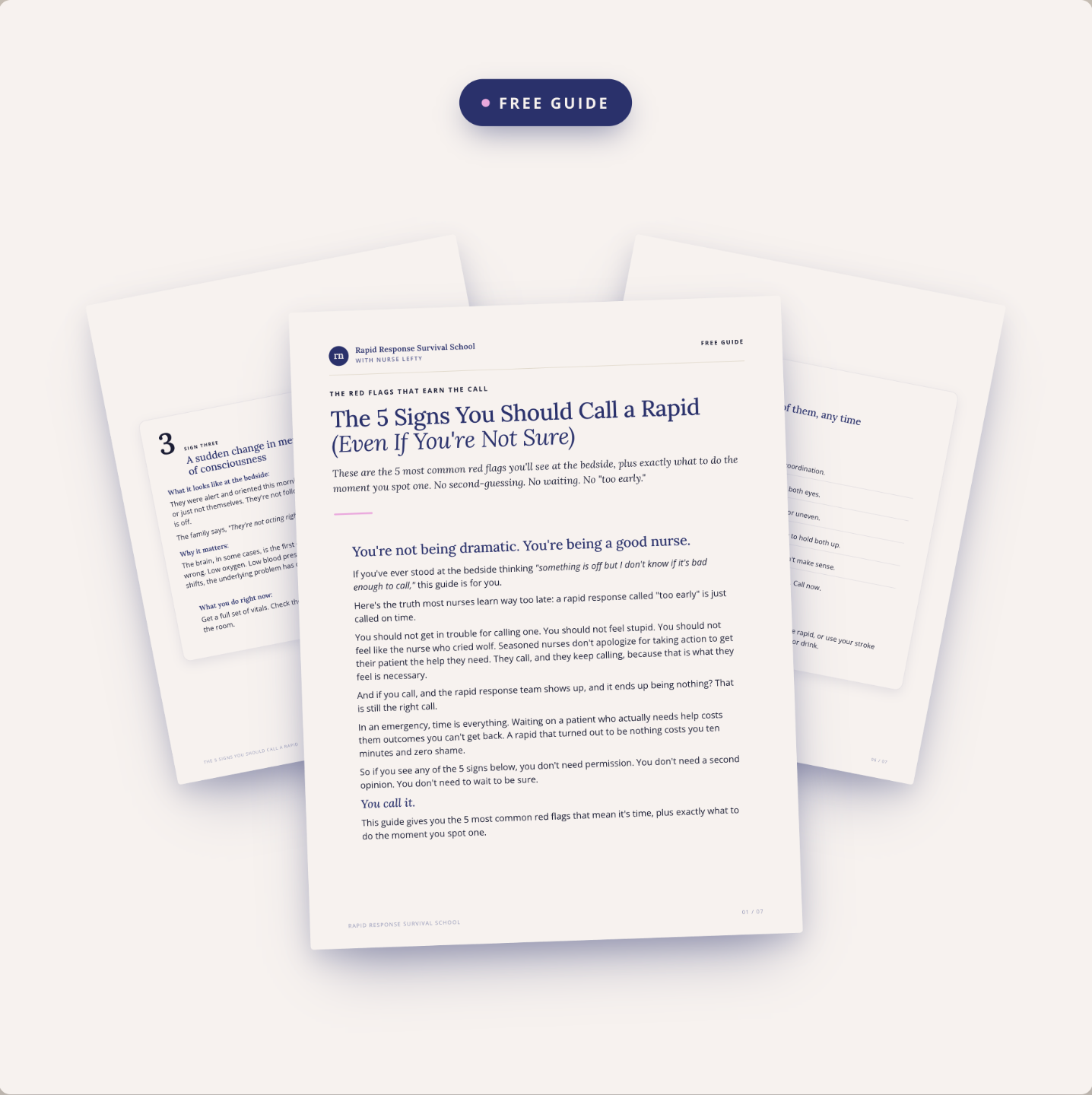
Your Free Guide
Stop Hesitating To Make The Call
Start with 5 Signs You Should Call a Rapid. The five most common reasons you should absolutely be calling a rapid response, in plain language, with nothing to decode.
It's a guide you can read before your next shift and keep on your phone.
You Don't Have To Know It All. You Just Have To Know Where To Focus.
Pick the one that matches where you are right now.